

On May 18, 2026 William Buswell discovered Catharus thrush at the Fenway Victory Gardens in Boston. It was clear that this was either a Gray-cheeked or a Bicknell’s Thrush, but these similar species require recordings of their song (or in-hand measurements) to be conclusively distinguished during migration. Luckily, the bird was faintly singing in a video that William took when he originally found it, and the spectrogram was posted to the Massachusetts RBA Discord server for help with the identification. The original spectrogram was extremely faint, but the song did appear to rise near the end, which would indicate Bicknell’s over the more expected Gray-cheeked. The plumage and call notes were also supportive (although neither can be considered diagnostic).
That afternoon, William and others returned to the gardens to obtain more audio of the bird. Several observers were able to hear the bird singing that evening and to get some clear recordings of the bird’s song and confirm its identity as Bicknell’s Thrush.
While currently a species on the review list, Bicknell’s Thrush was not always so rare in Massachusetts. In 1888 this species was documented breeding on Mount Greylock in Berkshire County and a population continued there for most of the next century. In the 1960s this population began to decline, and after 1972 they were extirpated from Mt. Greylock, and therefore also extirpated as a breeder in Massachusetts (Veit and Petersen 1993). While much of the population surely flies over the state each year, the MARC has thus far accepted only five records of this species in Massachusetts. Their secretive nature and the fact that they do not always sing during migration makes them challenging to confirm and the committee has been divided on what standards to hold even for a bird in hand. Their rarity in the state is also perhaps due to our close proximity to the species’ breeding grounds elsewhere in New England. This may mean that they are less likely to stop over on the ground within Massachusetts since most can complete a movement from the northern Appalachians or mid-Atlantic region to their breeding grounds in a single jump. The individual in Boston could have arrived on the night of 16-17 May, since that was an excellent migration night but had some rain showers overnight that might have grounded a bird just before it reached breeding mountains to the north. A similar bird, likely also a Bicknell’s, was observed at Mount Auburn Cemetery on 17 May but never vocalized and was not refound on 18 May (the day the bird was found in the Fenway). It could be that both birds arrived under the same conditions on the same night.
If accepted, this would be the sixth modern record of Bicknell’s Thrush in the state, and the first in Suffolk County.
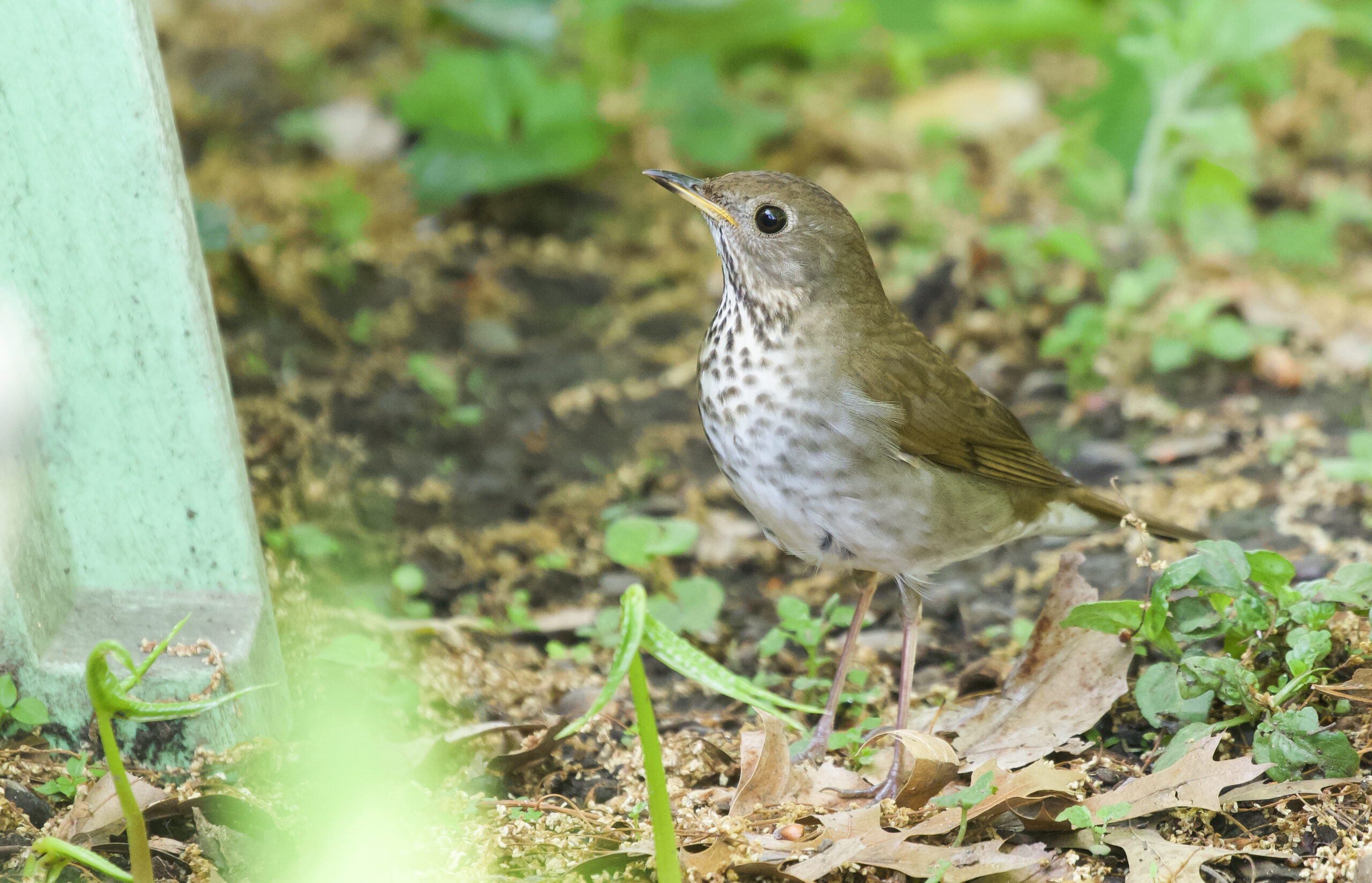
20 May 2026, Boston. Photo by Will Sweet
Maybe most surprisingly, this individual remained at the Fenway Victory Gardens for four days (through May 21). It provided excellent views to many birders, foraged around the garden plots, and even continued to sing occasionally. If accepted, this will also be our first modern record to have remained for more than a day.
Literature Cited
- Veit, R.R., Petersen, W.R. (1993). Birds of Massachusetts. Lincoln, Massachusetts: Massachusetts Audubon Society