Barnacle x Cackling/Canada Goose hybrids in North America have long been the source of speculation. Where are these birds coming from? Which parent represents a vagrant into the other’s usual breeding range? Some speculate that Barnacle x Canada Goose should be more likely in North America due to the greater numbers of Canada Geese than Cackling Geese in Greenland. However, given the frequency of hybrids occurring in the Northeast United States that display traits consistent with Barnacle x Cackling, something else must be going on.
On October 27th, 2017 a Barnacle Goose (Branta leucopsis) was found in Westfield, Hampden Co. (accepted record 2017-100). It was associating with a Richardson’s Cackling Goose (Branta hutchinsii hutchinsii) and the two appeared to be a pair, staying around the area through January 1st, 2018.
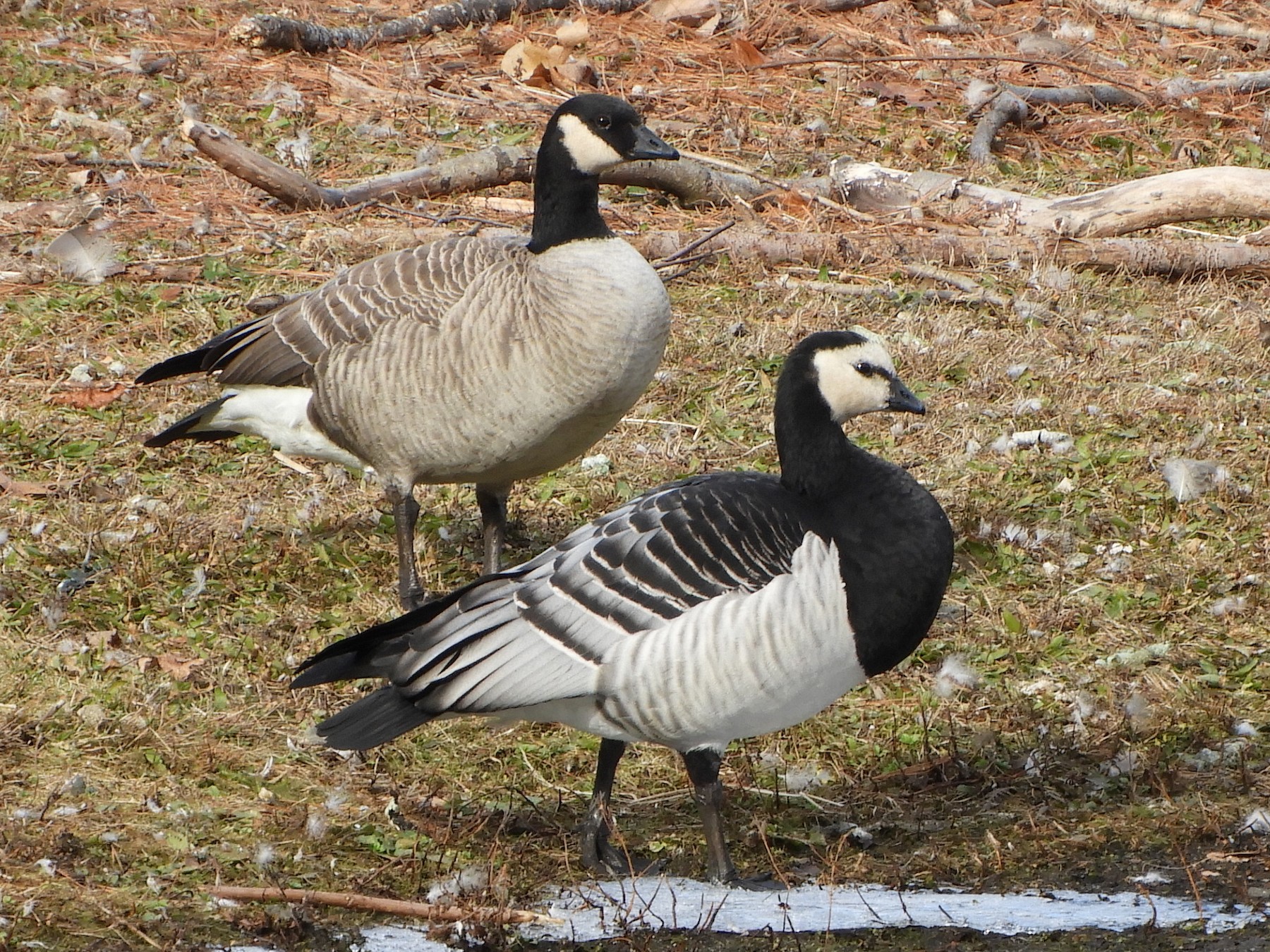
Cackling Goose and Barnacle Goose in Westfield. Photograph by Bill Lee.
On October 12th, 2020 a Barnacle Goose was found in Whately, Franklin Co. (accepted record 2020-098). This time instead of a Cackling Goose accompanying it, there were four Barnacle x Cackling Goose hybrids. This was obviously a family group given to the hybrids’ close association with the adult Barnacle. The group stayed in Whately through the 16th, then relocated to Northampton on the 17th before departing. This family group was present in East Windsor, Connecticut from October 20th to 24th. From November 24th, 2020 through January 2nd, 2021 a family group of one Barnacle Goose and four Barnacle x Cackling Geese were present near Westtown, Orange Co., New York. Despite being fairly distant from the Connecticut sighting, the presence of such a rare species along with an even rarer group of four hybrid young makes a solid case that the New York record represents the same family group.
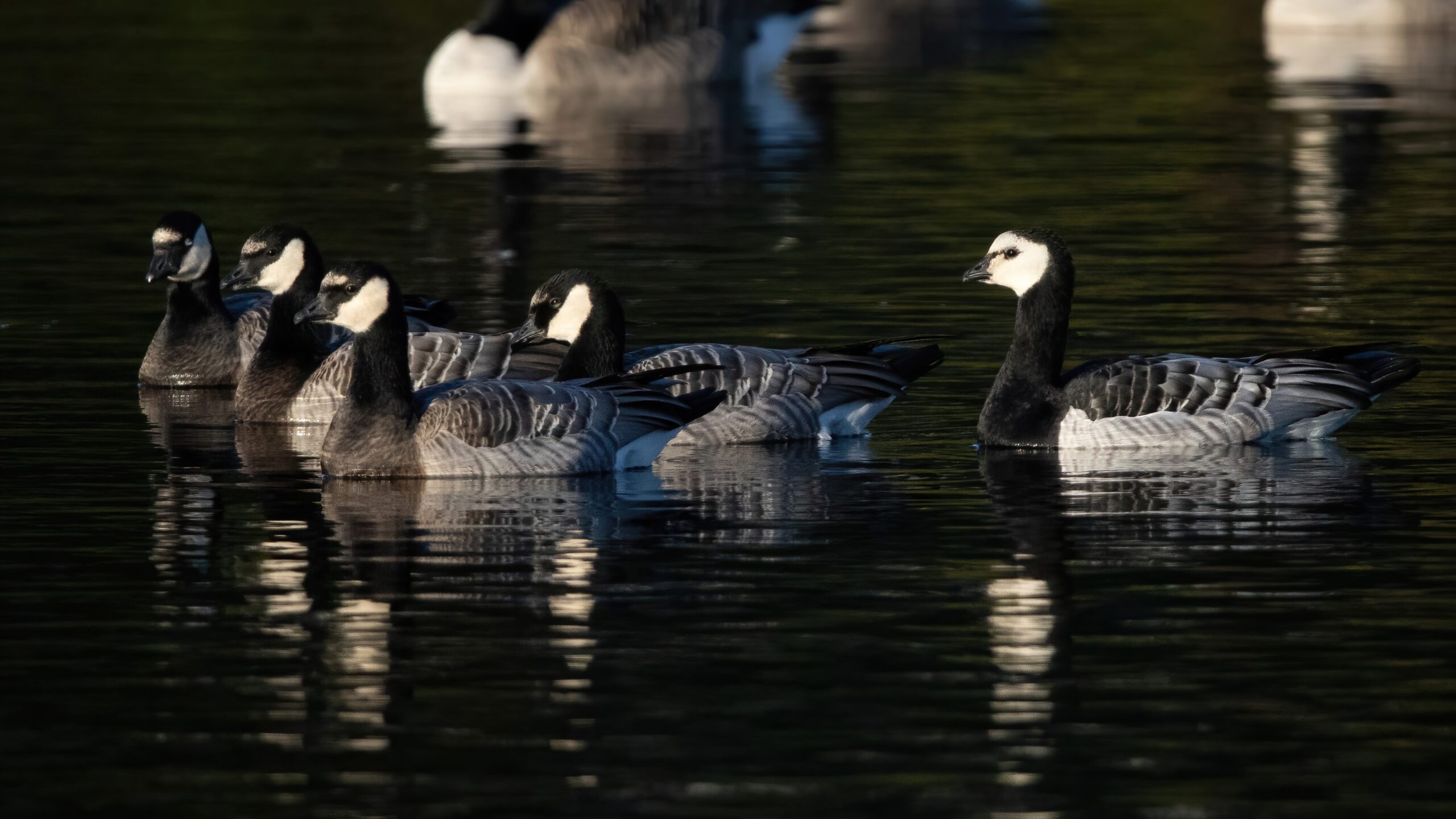
Barnacle Goose (right) and four Barnacle x Cackling Geese in Northampton. Photograph by Sam Zhang.
By analyzing plumage details, it can be concluded that both the 2017 and 2020 Barnacle Goose records pertain to the same individual. Although there are some minor differences between the three years it was unaccounted for, it seems clear that this is the same bird. In the 29th report of Massachusetts Avian Records Committee the committee voted to formally treat these two records as pertaining to the same individual. We are not aware of previous use of specific plumage details (face pattern in particular) helping to establish that two Barnacle Geese in successive years pertain to the same individual, but it may be possible to connect more records throughout the Northeast when close up photos are obtained. The connection of these two records also represents a rare instance of wild hybrids with known parentage.
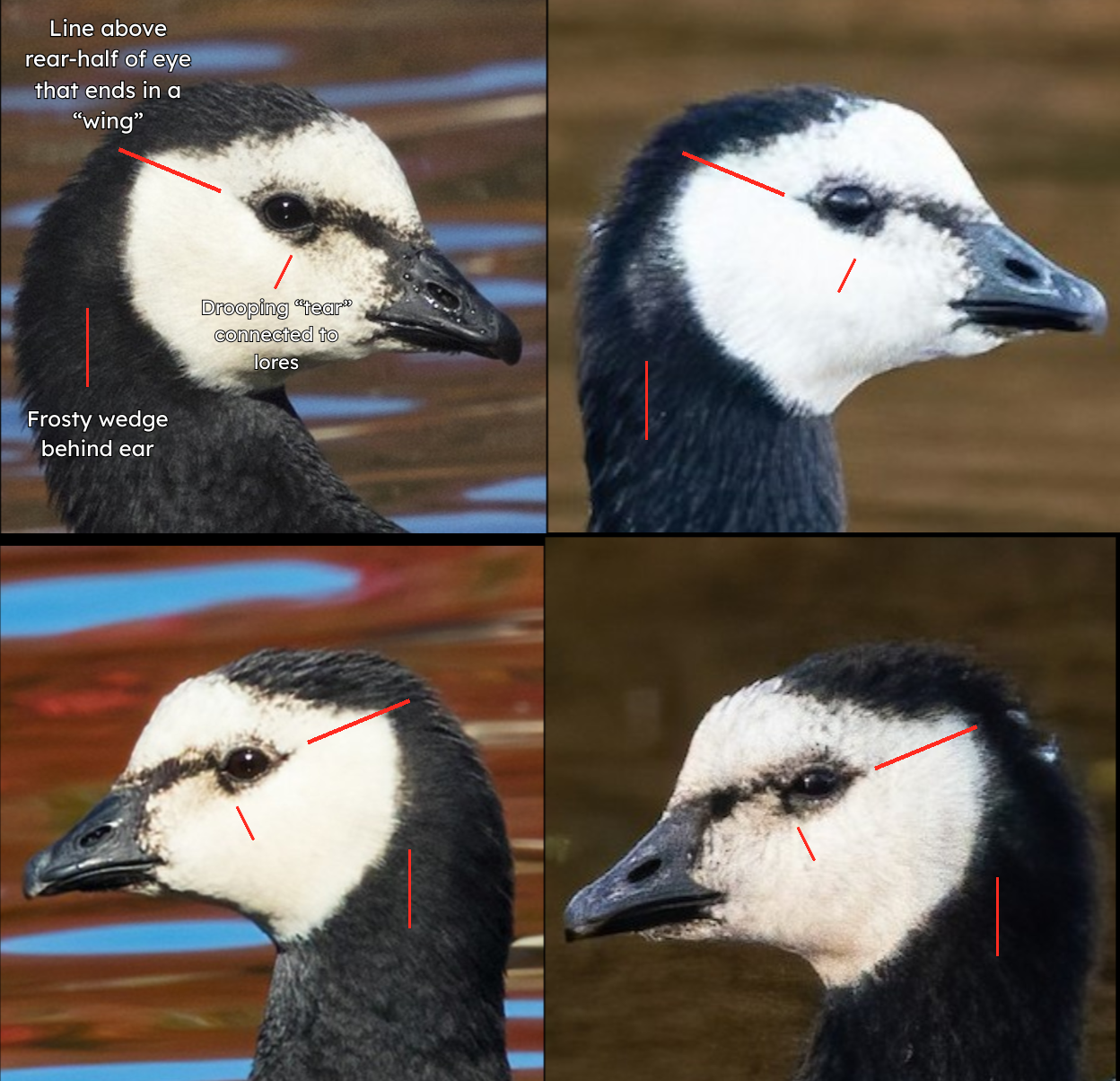
Left: 2017 bird. Photographs by Joe Oliverio. Right: 2020 bird. Photographs by Sam Zhang.
While exciting, this confirmed family group is not entirely unique. In November 1984 a very similar group was found in Southbury, New Haven Co., Connecticut. A Barnacle Goose and a Richardson’s Cackling Goose (the latter at the time considered conspecific with Canada Goose) were observed together with two hybrid offspring (Szantyr 1985). This group remained in the area until January of the following year. Although almost all Barnacle Geese were presumed to represent escapees during the 1980s (and although the overall global population of most species of geese in Greenland was much lower), the observation of these birds helped to establish Barnacle Geese as wild vagrants to the United States rather than just escapees, given that it surely must have paired with the Cackling and migrated together from the Arctic breeding grounds. The 1984 birds were perhaps the first family group of this kind documented in the United States, but in the years following more and more records of birds like this have accumulated, especially since 2005.
The Massachusetts hybrids were identified as Barnacle x Cackling Geese in 2020 based on visual field marks alone, without the knowledge that the same Barnacle parent had been observed paired with a Cackling Goose. This lends more credibility to the conclusive identification of these hybrids in the field based on structure and proportions. This case is another useful addition to the puzzle and it helps us to understand more about where and how hybrids like this occur.
Literature Cited
- Szantyr, M.S. (1985). A Barnacle Goose in Southbury, With Comments About The Status of Barnacle Goose in North America. The Connecticut Warbler, 5(2), 16-18. https://ctbirding.org/wp-content/uploads/2017/01/CTWarblerVolume05.pdf?x16306