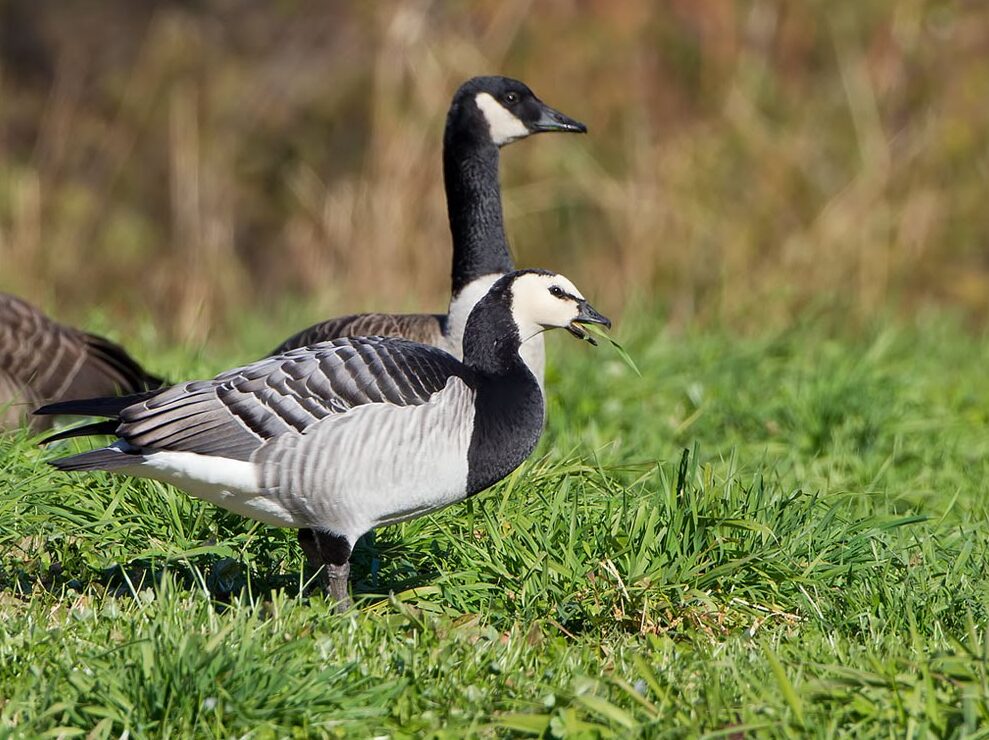
6 Nov 2011 West Newbury. photo by P. Brown.
25 recordsMARC number Decision Count Location County Arrival Departure Observers Notes Report 1885-001 Pr 1 North Eastham Barnstable 11/1/1885 11/1/1885 NOT ORIGINALLY IN DB; required review of 1st annual report for MJI to capture; shot. From 1st report: This record was of a bird shot at North Eastham, 1 November, 1885. There are many recent reports including birds that are known to have escaped from captivity. 1 1990-012 NA 1 Lexington Middlesex 12/6/1990 12/7/1990 [this record was not in the database, since none of the Not Accepted records from that report were preserved in the DB; we re-entered it from the 24th report] 24 2002-001 A 1 Lynnfield Marsh/Wakefield Middlesex 2/17/2002 2/19/2002 Fay Vale, Marj. Rines 7 2003-003 A 1 Model Airplane Fields, West Bridgewater Plymouth 3/22/2003 3/22/2003 Jim Sweeney 8 2003-004 A 1 Tri-town Beech Pond, at end of Old State Road, Whately Franklin 4/13/2003 4/14/2003 S. Smolen-Morton 8 2004-005 A 1 Cherry Hill Reservoir, West Newbury Essex 4/15/2004 4/24/2004 Tom Wetmore, D. Larson (ph) 10 2005-005 Pr 1 Bolton Flats Worcester 3/29/2005 3/31/2005 from 10th MARC report: The identity of this goose was not in question, but since it was associating with a goose that was thought by many to be a hybrid Barnacle x Canada Goose (B. canadensis), or possibly an aberrantly plumaged Canada Goose its origin was considered suspect. Although the time of ye 10 2007-020 A 1 Great Meadows MWR--Concord Unit Middlesex 10/11/2007 10/23/2007 Willy Hutcheson et al. 13 2007-041 A 1 Wards Fields, Sharon Norfolk 12/31/2007 1/12/2008 G. Leganza 13 2008-010 A 1 North Amherst Hampshire 3/22/2008 3/22/2008 D. Peake-Jones, B. Zajda, S. Surner (photos) 13 2008-036 A 1 Orlando's Ponds, Brookfield Road, Charlton Worcester 12/3/2008 12/13/2008 14 2009-037 Pr 1 Morning Glory Farm, Edgartown Dukes 10/20/2009 10/20/2009 from 15th MARC report: One adult photographed at Morning Glory Farm, Edgartown, Dukes, October 20, 2009, caused a stir until it was revealed that a nearby aviculturist had one Barnacle Goose missing (2009-37). 15 2010-008 A 1 Mill Pond, South Egremont Berkshire 2/12/2010 3/16/2010 Sheila Carroll* (ph), Mark Lynch†* (ph) 15 2010-037 A 1 Concord Rotary, Concord and School St., Acton Middlesex 10/20/2010 12/17/2010 David Sibley*, ph. K. Klasman, ph. D. Mitev, ph. Erik Nielsen, ph. Pete Wrublewski 15 2011-050 A 1 Upper Artichoke Reservoir, West Newbury Essex 11/6/2011 1/3/2012 Phil Brown* (ph), m. ob 17 2014-049 A 2 Maple Farm Sanctuary, Mendon; later Nine Acre Corner Worcester 3/1/2014 3/31/2014 Ian Davies, Cheri Ezell* (ph) 19 2015-004 A 2 West Rd. Sandbar, Longmeadow Hampden 1/2/2015 1/16/2015 S. Motyl (ph) 19 2015-013 A 3 River Road, Agawam Hampden 12/26/2015 12/26/2015 S. Motyl* (ph) 20 2017-100 A 1 Westfield Rd, Westfield Hampden 10/27/2017 1/1/2018 Dorrie Holmes†* (ph) SAME BIRD ISSUES: voted unanimously to consider 2017-100 (27 Oct 2017-1 Jan 2018) and 2020-098 as the same bird, with the latter a bird returning with several hybrid Cackling x Barnacle Geese in tow. Lilly Morello presented compelling evidence that specific aspects of face plumage confirm these as t 22 2019-122 A 1 Turner's Pond, Milton; Franklin Park, Roxbury Norfolk/Suffolk 11/21/2019 12/4/2019 Pat Dolan*, Andy Sanford (ph) combined as same bird between several sites within 20 miles of each other and MARC members agreed to that treatment; plumage same between individuals and appearances at new sites coincided with disappearance from previous ones 24 2020-025 A 2 Vaughan Hill Rd. fields, Rochester; Lake St. Ponds, Acushnet; Acushnet River, Acushnet Plymouth/Bristol 1/15/2020 3/18/2020 Neil Dowling* (ph), m. ob. 24 2020-065 A 1 Quabbin Reservoir--Windsor Dam/Park HQ, Belchertown Hampshire 11/23/2020 11/23/2020 Larry Therrien* (ph) 25 2020-098 A 1 Tri-Town Beach, Whately & Smith College--Paradise Pond, Northampton Franklin/Hampshire 10/12/2020 10/17/2020 Kevin Barnes*(ph), Sasha Auer* SAME BIRD ISSUES: the MARC voted unanimously to consider 2017-100 (27 Oct 2017-1 Jan 2018) and 2020-098 as the same bird, with the latter a bird returning with several hybrid Cackling x Barnacle Geese in tow. Lilly Morello presented compelling evidence that specific aspects of face plumage confirm t 25 2020-099 A 1 Turners Falls Power Canal, Greenfield Franklin 11/23/2020 12/16/2020 Edward Lewis* (ph), Sue Lewis* 25 2020-100 A 1 Davis Farmland fields, Sterling Worcester 11/28/2020 12/6/2020 Nick Newberry*, Better Robo (ph) 25
STATUS IN THE EAST: The population of this species is growing rapidly in Greenland and northern Europe. For example, the Greenland population, according to Worden et al ( 2004) increased from 9,000 in 1959 to 54,000 in 2003. There are over 225 records from North America with the earliest being a bird collected at James Bay, Quebec in 1867. Although many records have been dismissed as escaped birds, a pattern of occurrence has emerged in northeastern North America, and most records probably pertain to wild birds. In at least one instance, a record of escaped Barnacle Geese in the state has been proved and vigilance is required when considering records of this species. The known escapes pertain to a family group of six birds that was present in Osterville (Barnstable County) from 18 Jan – 28 Feb 1991. It was assumed that this group was the same known family group from Nova Scotia that disappeared from that area on 8 Jan 1991 after a very hard freeze (American Birds, The Winter Season, 45 (2)).
From Massachusetts Avian Records Committee ballot by Marshall J. Iliff:
- The VAST majority of records hail from the following states: MA, CT, RI, NY, NJ, DE, MD, VA, and NC. This perfectly matches the pattern of occurrence for Greenland Greater White-fronted Goose, although admittedly they become harder to detect as one moves west. But note that White-fronted Geese (and Cackling Geese) are more regular in MA than ME, for example. Records away from the East Coast are few and while they have occurred throughout the country, the concentration in the Northeast is dense (5-10 sightings annually in the past decade). This strongly suggests to me a pattern of natural vagrancy.
- The majority of records occur between October and December, corresponding with fall migration. Some are found throughout the winter as far north as Massachusetts, and a secondary peak occurs in February-April when geese are northbound. Summer records are quite scarce. The majority of records pertain to adults. I think this is the expected pattern of vagrancy in geese, since prospecting lone adults may wander to pre-migratory staging (or molting) grounds, while hatch-year birds typically migrate in family groups with their parents.
- Hybrid Barnacle x Richardson’s pairings are known, which I believe is expected if Barnacle Geese wander some during summer and wind up breeding among Richardson’s Geese in the High Arctic and then migrating with them.
- A fair number of Barnacle Goose records have occurred in flocks (or areas) that also have Greenland Greater White-fronted Geese and Cackling Geese.
- Barnacle Geese occur mostly with migratory Canada Goose flocks (e.g., B. c. canadensis), while relatively few are found with resident “golf course” geese.
- Known escapees have occurred, but are rare (Osterville birds excepted). Note however that some escapees have pertained to family groups, which I believe are more suspect.
- I believe the time is gone that Barnacle Geese be considered of “questionable” natural occurrence. The pattern of natural vagrancy is strong and getting ever stronger.
Author: Jeremiah R. Trimble and Marshall J. Iliff